Where the story begins
The hinoe uma belief did not emerge from ancient wisdom or careful observation. It started with popular fiction. In the early 1680s in Edo-period Japan, a true story circulated about a young woman named Yaoya Oshichi who, infatuated with a man she had met during a fire evacuation, set fire to her neighborhood hoping to see him again. She was executed at 16. Playwrights and storytellers latched onto the tale. One detail, almost certainly invented, attached her birth to a fire horse year. The association stuck: fire horse women were dangerous, headstrong, fatal to the men around them.
That fictional detail, originating in puppet theater and popular prints, propagated forward through every subsequent 60-year cycle. By the time it reached 1966, it had the weight of three centuries behind it.
The 60-year arc
The birth rate, 1960 to 1972
Japan total fertility rate (children per woman)
The shape of it today
The 1966 cohort is still visible. Japan's 2025 population pyramid, published by the National Institute of Population and Social Security Research, shows a clear notch at age 59: fewer people on both sides of the pyramid than in the years immediately above and below. The people born in that compressed year are your colleagues, your clients, turning 60 in 2026.
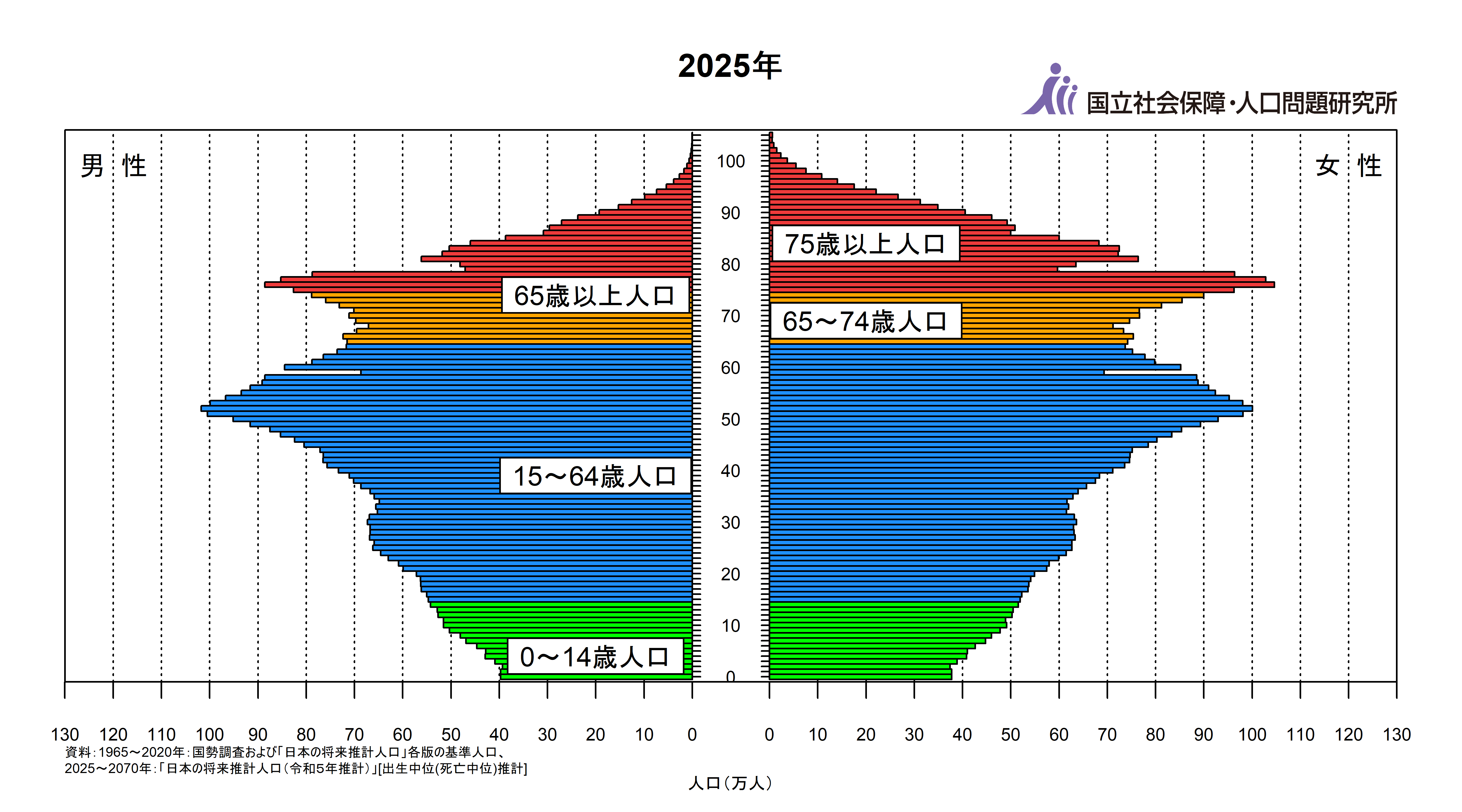
Japan population pyramid, 2025. Each horizontal bar represents one birth year, with men on the left and women on the right. Bar length shows the size of that cohort still living today. The notch at age 59, the 1966 cohort, is visible on both sides: narrower than the years immediately above and below. Source: National Institute of Population and Social Security Research (IPSS), 国立社会保障・人口問題研究所.
It was not just superstition
The standard framing is that a superstition caused rational people to behave irrationally. The more careful reading, developed by sociologist Kikkawa Toru in recent research, is more interesting. Most couples who avoided pregnancy in 1966 were not primarily driven by a belief in the curse. They were responding to something broader.
From 1964 onward, newspapers, magazines, and television covered the approaching fire horse year extensively: warnings to be careful, but also campaigns to dismiss the superstition, which had the effect of ensuring that everyone in Japan knew it was coming. Grandparents who had lived through 1906 passed on concrete stories: women whose engagements were broken, families disrupted. The media created shared awareness; living memory created social pressure. And birth control methods were being newly encouraged at exactly this moment, giving couples the practical means to act.
The fire horse belief functioned less as a conviction and more as a permission structure: a culturally legible reason to do something many couples were already inclined toward. The script did not need to be believed consciously to shape behavior at scale.
Kikkawa's analysis also notes that births in 1965 and 1967 were higher than expected: couples were timing, not abstaining. The dip was the visible part of a three-year pattern of deliberate reproductive planning, with the fire horse year providing the organizing logic.
The same mechanism, different scripts
It is tempting to read 1966 as a specifically Japanese story, a product of zodiac culture and tight social conformity. The mechanism, though, is not unique to Japan.
Japan, 1966
A 280-year-old piece of Edo-period fiction, amplified by mass media and living family memory, produces a 26% drop in the national birth rate in a single year among an educated, industrialized population.
United States, ongoing
Studies find measurable dips in economic activity, stock trading volume, elective surgery bookings, and travel on Friday the 13th. The effect is smaller, but the mechanism is identical: a shared cultural script, not consciously chosen, producing population-level behavioral shifts.
Neither population is acting irrationally in the sense of ignoring evidence. They are acting socially: aligning with what people around them recognize and expect. That is a different kind of behavior, and harder to examine from the inside.
The question worth asking
The coaching-relevant insight from 1966 is not that superstition can override reason. It is that the scripts shaping behavior most powerfully are usually the ones no one is consciously following.
The couples who avoided pregnancy in 1966 were not, for the most part, sitting down and deciding they believed in the fire horse. They were navigating ambient social pressure, family expectations, and a cultural atmosphere so saturated with the coming year that avoiding it felt like the sensible, responsible thing to do. The belief did not require conviction. It required recognition.
The question is not whether your decisions are being shaped by invisible scripts (they are). The more productive question is which ones, and whether you would choose them if you could see them clearly. The fire horse is useful precisely because it is visible: a moment where the script left a mark in the data. Most scripts are not that legible. They produce their effects quietly, in hiring decisions and funding patterns and assessments of who looks credible, and they do not show up in population pyramids sixty years later. They just shape outcomes, unexamined.